

It’s 9:10 a.m., on Monday, April 13. The sun shines brightly in the morning sky, warming Wheeling to a balmy, unusually warm spring day. In a rented Toyota Camry, I’m enjoying Olipop’s Mountain Dew knockoff ‘Ridge Rush’ as I rush towards the ridge a few miles east of Wheeling for something else unusual.
Taking Exit 10 towards the Highlands, I lumber through three traffic lights as the most insane motorists this side of the Mississippi River frantically switch lanes sans turning signals to reach Cabela’s, Chick-fil-A, Walmart, or some other cookie-cutter big-box store. Ever-mindful of the driver in front of me lest I pick up a charge with Enterprise, I proceed with caution.
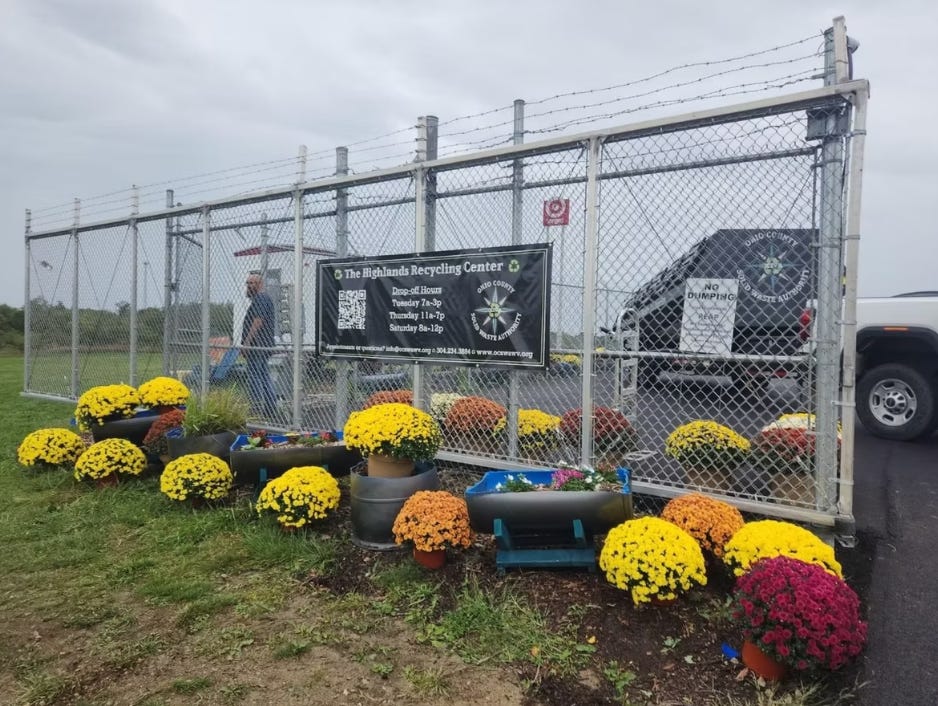
Tucked behind Best Buy and adjacent to Hobby Lobby’s sits a single-wide trailer and a barbed wire fence. Here lies the Ohio County Solid Waste Authority, a governing body created by the state Legislature to oversee the efficient and proper disposal of solid waste in the county. The fenced in recycling center may be unwelcoming at first, but the trailer doubling as its headquarters, meeting location, and staff room sees soon-to-bloom tulips flush with green.
I’ve been here before. From June 2024 through March 2025, I was employed by the Authority and served as their Community Relations Coordinator and the Recording Secretary for their Board of Directors. I worked with county schools to effectuate a recycling program, attended community events to promote the Authority, helped recyclers at the center, drafted organizational documents, and wrote meeting minutes. That was then, and this is now.
Now, I’m here for a highly unusual Special Meeting called by the Board of Directors – a Board and Authority that is required by law to follow the state’s Open Governmental Meetings Act. That law says governing bodies such as the Ohio County Solid Waste Authority can create their own rules for notifying the public of a meeting, and the Authority’s rules state they’ll publish notices at the City-County building in downtown Wheeling three days prior to a meeting.
But there was no meeting notice posted on Wednesday, April 8. There wasn’t one on Friday, either, which would suffice their “three (3) days” deadline to notify meetings listed in their bylaws. There wasn’t a notice posted on Saturday, or Monday – the day of the meeting – either. Despite that lack of public notice, I was made aware of the meeting. A screenshot of the agenda stated it started at 9:30 a.m.
I’m entering the trailer for the first time around 9:28 a.m. Its millennial gray walls, while cliche, create a bright and inviting atmosphere. Inside are Executive Director Rebecca Friend and David Neff, Logistics Coordinator. I offer a “hi” and get one in return. Some small talk ensues, but it’s awkward. “Where is everyone,” I think to myself. Then I get a buzz on my phone. The message says that, as of the day prior, the meeting had moved to 10:00 a.m. “Weird, that doesn’t appear to be proper, state-mandated public notification,” I ponder.
Hanging out in one of the four chairs set out for the public, I scroll my emails and type up a few responses. Ten minutes to the hour Robert Luchetti, Jr. enters the room. He’s the Board’s Vice Chair. I’m not sure if he recognizes me, but he offers a “hello.”
Quickly, he retreats to a backroom with Friend and asks if she has spoken with Randy Russell, the Ohio County Administrator. “Yes,” Friend replies curtly. Luchetti continues to say something to the effect of Russell believing the Board should continue with its meeting. Then, silence. A rough, rushed sound is heard that appears to me to be a marker on a white board. One can only assume what was written, but chatter about the meeting ended with that.
As 10:00 a.m. approaches, other Board members enter. Mitchell Haddad compliments my pale yellow nail polish. Earl Forman, chair of the Board, is next. Then Dr. Vincent DeGeorge. And last, Erin Cuffaro, who offers me a warm smile. All the players are here.
Before the meeting starts, DeGeorge distributes a letter he says is from his attorney. This meeting is really about him. Every part of the special meeting’s agenda is directed - implicitly or explicitly - at him. From what he says, the letter is calling for deescalation, seeking to cancel the meeting before it can begin.
“I’m offering my silence to this Board, I’m offering to resign so that this Board stops [the] sham retaliatory efforts against me for doing my due diligence as a Board member,” DeGeorge said. “So you’re willing to resign,” Luchetti quipped. DeGeorge said he had done so repeatedly.
The letter further stated that if the meeting was not cancelled, it could see the organization face legal consequences.
“Are you suing [the Ohio County Solid Waste Authority],” chimed Friend.
In my experience as a former employee, she effectively runs the voluntary Board. Every document that finds its way in front of the Board is authored by her, or sometimes by me during my tenure. She created the agendas, confirmed meeting minutes during my tenure and now, presumably, writes them herself, and emails the Board when meetings are to occur.
“No,” DeGeorge replied. “I am trying to avoid consequences to [the Ohio County Solid Waste Authority].”
DeGeorge claimed the meeting in-and-of-itself is escalatory. “Is he wrong?” On the agenda is his censure – a rare rebuke by a governing or legislative body that expresses dissatisfaction with a member’s conduct – a plainly escalatory action by definition.
Arguments continued. Board members talked over one another, all but devolving into a shouting match. Accusations swirled.
Luchetti said that “no one’s been so obstructive and so completely regardless [sic] of parliamentary procedure” than DeGeorge.
Really? What part of Robert’s Rules of Order – the standard guide for parliamentary procedure – allows for a governing body’s quorum to fail to notify a public meeting? Which part allows said governing body to change the time of its already questionably-legal meeting the day before, without notice? Where in Robert’s Rules of Order does it say a quorum of a governing body can discuss matters of the public outside of a gavelled-in meeting?
Forman finally strikes a wooden mallet against the table, signifying the start of business.
Quickly, the Board gets to work on an agenda including documents with such legalistic and wordy titles as “Addendum: Enforcement of Board Governing Procedures” and “Board Response for the Official Record Regarding Previously Distributed Mischaracterizations of OCSWA Governance and Operations,” as well as the “Formal Censure Resolution Regarding Conduct of Board Member Dr. Vincent DeGeorge.”
DeGeorge claims that this meeting is retaliation for his calls for the organization to create a budget–and he’s probably not wrong. After reviewing recent Board meetings, DeGeorge has continuously advocated for the Ohio County Solid Waste Authority to create a budget. These calls regularly cause arguments during Board meetings.
While it’s not required by law for a solid waste authority to have a budget, one would be forgiven for assuming an organization utilizing public funds in the form of legislatively-mandated landfill tipping fees, and local, state, and federal grants, would be required to have one. Even farmer’s markets operate on a budget. Not the Ohio County Solid Waste Authority, though.
The organization even took the dubious action to table any discussion of a budget.
Wait, isn’t this the same organization obsessed with Robert’s Rules of Order?
During the meeting, Robert’s Rules of Order was called upon as if it were a holy book. Luchetti, Haddad, and Forman regularly conjured the idea of Robert’s Rules – specifically, their allegations that DeGeorge had failed to follow the parliamentary procedure – as a defense for the meeting and DeGeorge’s censure.
The action of the Board to table discussion of a budget is not a real action; the action is not based on anything Henry Martyn Robert wrote in his rulebook. You can’t table a discussion. When a motion is presented to the Board – or any governing body, for that matter – you can table said motion, but tabling discussion is meaningless – it’s unenforceable nonsense.
Throughout the meeting, Board members continued to fight over each other.
Members raised their voices, talked over each other, huffed, puffed, made side-comments, and generally acted in a blowhard-y manner. They interrupted each other, spoke on the same motion more than once, engaged in personal attacks, and made several frivolous points of order – almost exclusively by Haddad – to silence their opposition that were neither points of order – a specific tool in Robert’s Rules to flag a specific concern of rules being broken – nor were they properly ruled on by the chair, Forman, as ‘well taken’ or ‘not well taken.’
Were Robert to have been in one of three other chairs left for the public (in a county of 42,425), he would have shuddered at his name being used as a cudgel against one and not all.
No matter. The wordy documents and the censure were eventually adopted 4-1, with DeGeorge voting ‘Nay’ each time.
At the end of the meeting, Board members hung around as though some stone was left unturned.
“Congratulations,” DeGeorge quipped as Forman adjourned the meeting. “I don’t know that any of this is a celebratory thing,” Friend said, having sat silent for most of the Board meeting.
“We operate in accordance with state code and our operational government,” Luchetti said.
Do they? Again, this meeting was not, to my knowledge and experience, properly notified to the public. And the organization effectively concedes that point, too, as they’re holding a ‘re-do’ of the meeting on Friday, April 17, after having been made aware of – and denying – the lack of proper notice. Do they operate in accordance with state code?
“But see how you don’t say you operate according to the standard of best practices,” DeGeorge replied. “Because you know you don’t.”
“We don’t have to,” rushed Luchetti. “We do not have to use standard best practices.”
Maybe so, but what is the harm of operating on standard best practices? Such practices allow a governing body to be accountable and ethical.
“Where are these practices documented,” Luchetti asked DeGeorge.
“In the Ohio County Solid Waste Authority Board training, Ms. Vickers [sp?] states these standards…” DeGeorge says, as other Board members chime in, muddying the recording.
Forman, who had been fairly reserved throughout the meeting, now speaks after its conclusion.
“Dr. DeGeorge, you have an interesting way of, you speak truth only as you see it, and if anyone else sees it differently it’s not right,” Forman said. “That is a false and misleading way of presenting an idea and I personally find it offensive and reject it.”
Haddad, who wasn’t shy about his contempt for DeGeorge through numerous false points of order, speaks again.
“This is not an argument about a budget, it is an argument about arrogance,” Haddad said. “You cannot allege malfeasance and then not expect the people you allege the malfeasance against to come with receipts and say you’re literally the only person that says this.”
Haddad continues, “And you keep saying it to anyone you can get the attention of, whether they want to hear it or not.”
“I would say it’s a Board member’s obligation to raise red flags when they arise,” DeGeorge responded.
“So now it’s time to close ranks and move forward,” Luchetti said.
And, with that, we were done. Before I left the meeting, I was asked by Luchetti if I would be “kind enough to share that with us, we’d appreciate that.” With all due respect to Luchetti, who seems like an honorable man, I chose not to share this story with the Board before its publication.
With the meeting over, I retreated back to my rented car. I sat with myself in the air conditioning for a moment. Never in my three years of reporting on governing bodies have I experienced a meeting so vitriolic, so ideologically inconsistent, so controlled by ego and some invisible force that felt so peculiar. In many ways, this was a first.
I drove down to the City-County building once more. I wanted to triple-check that no notice was posted, and since only myself and DeGeorge left the meeting – leaving the rest of the Board in quorum, obfuscated from the public – I thought maybe, just maybe, I had missed something at the City-County building.
Nope. There was no meeting notice, just as there wasn’t a notice in the days or hours before.
I emailed the Board and the Authority’s Executive Director with a list of questions for them to respond to, including asking if the organization believes it is in their and the public’s best interest to not have a budget, what the Authority’s grants and tipping fees were, and whether they acknowledged that their April 13 meeting was improperly notified.
DeGeorge was the only member of the Board to respond to that request.
He stated he did not “think it is in the public’s or this [B]oard’s best interest to operate without a budget.”
In response to the question regarding the Authority’s tipping fees and grants, DeGeorge said, “As a [B]oard member I do not know our annual income from tipping fees or grants, though I want to know that, because that annual information is not collected and compiled in an organizational budget. As a Board member we simply need to have that basic financial information (annual income, expenses, etc) so that we can make informed financial decisions. This is a primary reason I advocate for an organizational budget.”
DeGeorge says that, as of the last meeting, he recalls the organization’s Certificate of Deposit account having “nearly $110,000” and the organization’s operational account having $50,000.
“One cannot responsibly manage hundreds of thousands of dollars in public funds without a budget; it is fiscally irresponsible,” DeGeorge continued. “Instead of working to address [several red flags that have been raised], [the Ohio County Solid Waste Authority] is making extraordinary efforts to ignore the issues, and silence, remove, and retaliate against me. This has plunged the [B]oard into dysfunction and legal jeopardy.”